It’s a question I hear often during consultations. My answer usually starts with a question of my own: “What are you hoping it will help with?” If you’re hoping for firmer, smoother, healthier-looking skin, it helps to understand what collagen does—and what else your skin needs before you decide whether to add a scoop to your coffee.
What’s happening beneath the surface?
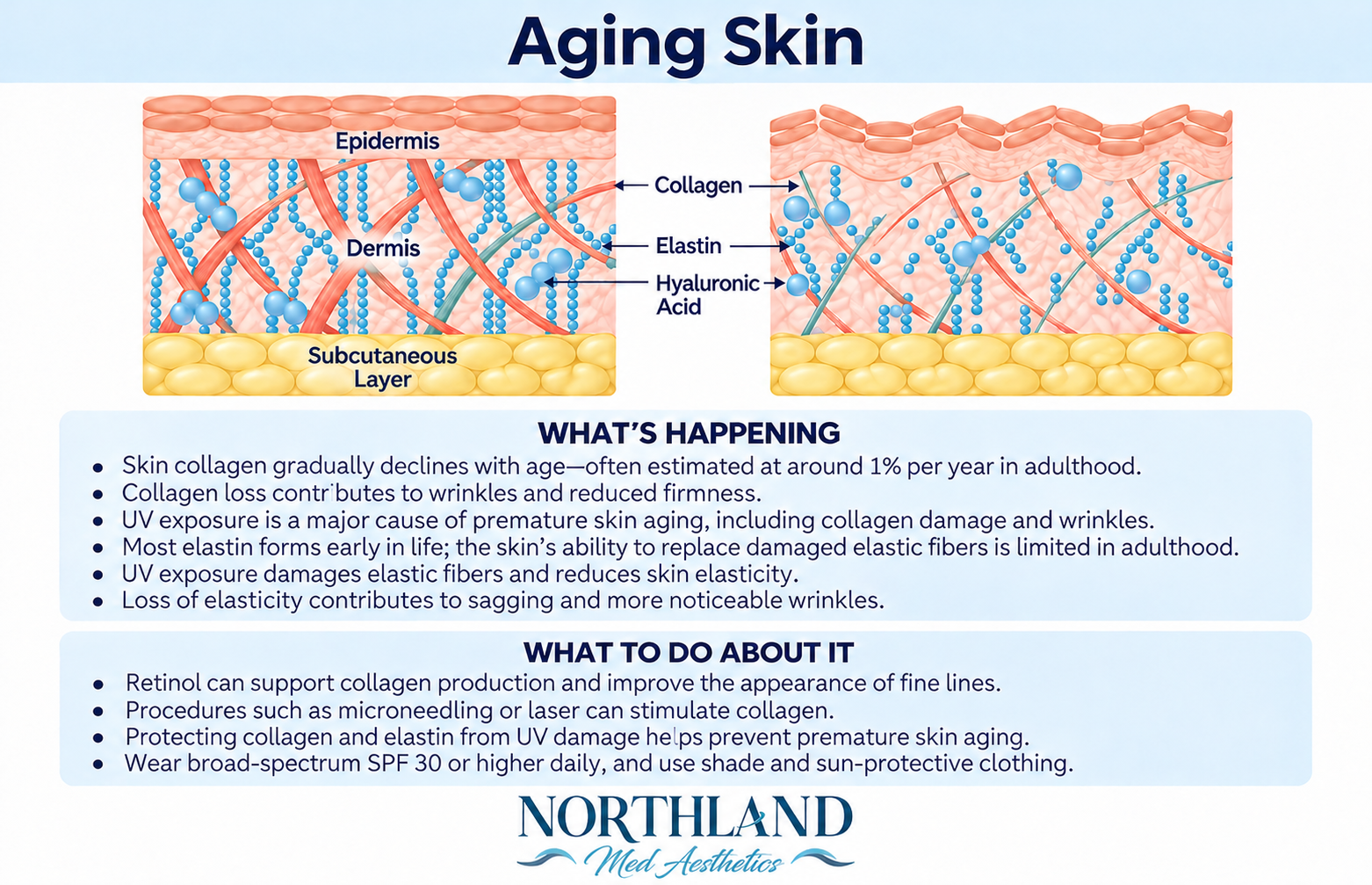
Collagen gives skin strength and structural support, while elastin helps it stretch and spring back. I like to think of collagen as the framework and elastin as the spring. As we age, collagen production slows and these supporting fibers become damaged or disorganized. You may notice finer, crepey-looking texture around your eyes, neck or chest; wrinkles that linger even when your face is relaxed; or skin that feels less firm and doesn’t bounce back the way it once did.
These changes aren’t only about collagen. Facial fat, bone and other supporting tissues change too, which is why one product or treatment rarely addresses everything we notice in the mirror.
Before adding more, protect what you have
We can’t stop time, and the hormonal changes of menopause can accelerate collagen loss. But there are meaningful things we can do to protect our skin and support its ability to repair itself. This is where I would start. If you’ve spent much time in my office, you probably know my first recommendation: sunscreen! Ultraviolet exposure damages collagen and the elastic fiber network. Daily broad-spectrum SPF 30 or higher (yes, even in the winter), along with shade and protective clothing, helps limit that damage. I usually recommend a mineral sunscreen you enjoy enough to wear consistently—and remembering your neck and chest.
My other foundation is an appropriate retinol or retinoid. These vitamin A-based products can support collagen production and improve fine lines and texture over time. The right strength and frequency depend on your skin. More irritation does not mean better results, so start gradually with guidance. Retinoids should be avoided during pregnancy.
What we eat matters as well. Our bodies need adequate protein for amino acids and vitamin C to make collagen. Regularly including foods such as peppers, citrus, berries and broccoli helps provide vitamin C. Meeting your nutritional needs is the goal; taking extra vitamin C doesn’t automatically translate into extra collagen.
Sugar also comes into this conversation through a process called glycation. Sugars can bind to proteins, including collagen and elastin, making them stiffer and less functional. That doesn’t mean an occasional dessert undoes your skincare! A balanced eating pattern and managing elevated blood sugar are more useful goals than fearing every sweet treat.
Smoking contributes to premature skin aging, while chronic stress can affect inflammation and skin repair. The exact effect of stress on visible collagen loss is harder to quantify than sun damage, but supporting sleep and finding manageable ways to reduce stress are worthwhile for your overall health.
You don’t need a perfect lifestyle before you can benefit from treatment. I simply want patients to have a useful daily foundation, rather than expecting a procedure—or a powder—to do all the work.
When your skin needs more support
Once we’ve considered those basics, office treatments can help address concerns that skincare alone may not adequately improve. The right choice depends on what bothers you, your skin, your budget and how much recovery time fits your life.
Microneedling creates controlled microscopic injuries that encourage a healing response and collagen remodeling. It can improve texture, fine lines and certain scars, with changes developing gradually over a series. Small biopsy studies have documented increased collagen after repeated treatments, but no single percentage predicts everyone’s results.
CO₂ laser resurfacing also uses a controlled injury to stimulate repair and collagen remodeling. It can address texture, wrinkles and certain scars, with recovery depending on the treatment’s depth and intensity. A lighter CoolPeel treatment and deeper resurfacing serve different needs; they are not interchangeable.
Broadband Light Photofacial is particularly useful for sun-related pigmentation and redness. There is also interesting research beyond those visible changes: a small study found that some aging-related gene-expression patterns shifted toward those seen in younger skin after treatment. That describes changes in gene activity—not rewriting your DNA or permanently stopping aging.
Injectable biostimulators such as Sculptra and Radiesse encourage collagen through different materials and tissue responses. Sculptra’s manufacturer cites a small tissue study showing a 66.5% increase in type I collagen at three months. That’s a biopsy measurement, rather than a promise of 66.5% firmer-looking skin, but it illustrates why improvement develops gradually. Radiesse research has also documented collagen remodeling and changes in elastin; how it is placed and diluted influences the treatment goal.
PRP and PRF use components of your own blood containing growth factors involved in repair. They may have a role for selected patients, although preparation methods and study results vary, and their evidence is less established than the marketing sometimes suggests.
These treatments offer different tools for different concerns. We choose a plan together, allow time for remodeling, and reassess rather than assuming everyone needs the same approach.
So, do I take collagen?
Sometimes I do! I’ll add it to my coffee as a convenient way to get a little protein in the morning. I don’t rely on it as my only protein source. When you swallow collagen, it doesn’t travel intact straight to your cheeks. Digestion breaks it into amino acids and small peptides, some of which can be absorbed and used by the body. Some studies report modest improvements in skin hydration or elasticity after consistent use over weeks to months. Other analyses raise important questions about study quality and industry funding. We can’t confidently promise that a particular powder will rebuild your skin, and we shouldn’t assume that taking more produces a better result. If you enjoy it, tolerate it and find it worth the cost, collagen can be an optional addition. I just wouldn’t put it ahead of daily sunscreen, an appropriate retinoid and adequate nutrition.
When someone asks me, “Should I take collagen?” I want to help them spend their time and money on what is most likely to support their goals. Sometimes that includes a supplement. Often, the most useful place to start is with the habits we repeat every day.
— Natalie 💙